
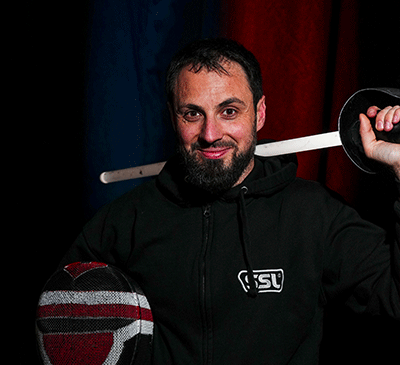
Today on the blog, I’m joined for an interview but the man who is undoubtedly the single greatest fighter in the history of Saber Tour, the “man of a thousand trophies”, Sebastien Berard.
——————————————————————————————————-
Sebastien, welcome to Saber Talk, let’s start at the beginning, how did you first get involved with LED Saber as a sport?
About ten years ago, after several years of long-distance running, I felt the urge to get back into a sport—something more fun and engaging this time. I had practiced fencing when I was younger, so I was naturally drawn to combat sports. However, I wasn’t interested in going back to something I already knew so well. I was hesitating between HEMA and canne de combat when I came across a podcast where Adrien talked about launching the first ever sport-oriented lightsaber school. As a sci-fi enthusiast, I was immediately hooked by the concept and signed up in the club’s very first year.
We have the 8th edition of the Open de France just around the corner (on the 20th-21st of June), how do you typically prepare for an event like this? Is it just an extension of normal training or do you increase the amount you practice in the run-up to the event?
What sets the Open de France apart from other competitions is that it takes place over two days. That means endurance and recovery are absolutely crucial in the lead-up. On top of my regular training, I add running sessions for cardio and striking drills—sometimes even on trees—to build arm strength and work on precision. That said, it’s important not to overdo it right before the event, to avoid the risk of injury.
We’ve seen you dominate both pool and elimination stages—do you approach those two phases differently, psychologically or tactically?
The pool and elimination phases are very different, both psychologically and tactically. In pools, the key is to preserve as many hit points as possible to ensure a high ranking. That means adopting a very cautious approach—you only commit to an attack if you’re almost certain you won’t get hit in return. To stay in the top ranks, you generally can’t afford to take more than one or two hits out of the 15 available points. So patience, observation, distance control, and timing are absolutely crucial.
On the other hand, elimination matches are all about gaining the lead. If you can land four or five points while only taking two or three, that’s a good trade. Once you’ve built a lead, it becomes extremely hard for your opponent to catch up. It’s really about relative efficiency—taking a few hits is acceptable as long as you land more during the same exchange.
And of course, since it’s single elimination, you have to stay focused at all times—even against opponents who seem like an easy win on paper. One or two careless mistakes can cost you the entire match.
As the undisputed best player in the world, you’re obviously a highly skilled fighter, how would you sum up your style in the arena? Has it changed at all over your time competing?
With over 15 years of fencing experience, my style is naturally heavily influenced by traditional foil. You can’t deny your roots. That said, foil and lightsaber combat are quite different. In foil, the bout stops at the first touch, whereas in saber, you need to think beyond the strike—you have to be in a position to defend immediately after landing a hit. So it becomes a much more tactical game.
Big lunges or overly aggressive actions can actually be a liability, because you might end up taking more hits on the return than you scored going in. That forced me to really rework my style—finding the right combinations of offense and defense that allow me to hit without getting hit in return. And since opponents’ styles are always evolving, I constantly have to question myself and try new things. That’s what makes it so exciting.
I think my biggest strength—and the reason for my consistency at the top—is my versatility. Many fighters are technically better than me in specific styles, but I’ve managed to stay ahead by being comfortable with both offensive and defensive approaches. It gives me the flexibility to adapt to my opponent and to the flow of each match.
Do you feel there’s a particular matchup or fighting style that challenges you more than others? If so, what makes it difficult to counter?
There are two particular styles that tend to give me the most trouble.
First, two-handed fighters who go all-in with aggressive tactics—breaking distance quickly and getting in close. That kind of pressure tends to neutralize one of my main strengths, which is distance control. Their two-handed grip also gives them faster follow-up strikes than I can usually manage. The upside is that this style is often quite predictable—fighters who commit to it tend to stick with it for the whole match. That allows me to anticipate their movements and gain a small lead early on, which can be enough to win in the end—but it’s never easy.
My worst nightmare, though, are the tall, explosive fighters like Jérémy or Guillaume. When they manage to get their game going, they can retreat faster than I can chase—meaning I can’t land hits, but they can still reach me thanks to their long reach. The key is to push them to the edge of the arena and take away that mobility—but of course, that’s easier said than done.
And then there are the technically brilliant fighters, like Amaury or Arthur. Against them, it’s all about finding and exploiting a small opening—but they adapt so quickly, it becomes a real cat-and-mouse game just to earn a few points. Those matches are always intense and demanding
Outside of fighting and refereeing, do you engage with the LED saber world in other ways—mentoring, club development, kit testing, etc.?
Yes, I’m quite involved in other areas of the lightsaber world beyond fighting and refereeing.
I spend a lot of time mentoring and training our elite fighters—helping them identify weaknesses and work through them. It’s a really rewarding experience, both technically and on a human level, as it creates strong personal connections.
I also support Arthur in developing our competition management tools, using my modest technical skills to help streamline how events are organized.
And finally, I do quite a bit of equipment development—initially for myself, but I always share the results with others. For example, I designed an ergonomic hilt with an integrated hand guard, which improves finger protection and grip stability. That in turn helps with both precision and safety.
A lot of fighters will listen to music while warming up or practicing, is this something you’ve ever given a try? If so, did you find it helped you to focus or improve your performance at all?
I think one of the advantages of experience—or maybe just age—is that I’ve done a lot of competitions over the years: in fencing, running, and now lightsaber. Over time, I’ve learned how to switch into match mode quickly and focus without needing music or any particular pre-fight ritual.
It’s also my way of avoiding putting too much pressure on myself. For me, this is first and foremost a fun sport. I don’t always respond well to high-stakes situations or intense pressure. What really helps me is staying cool-headed and remembering that, at the end of the day, we’re just big kids playing with glowing plastic swords—it’s not the Olympics!
That said, everyone’s different. Some people thrive under pressure; others get paralyzed by the fear of losing. My approach is to stay calm and clear-minded so I can make smart decisions in the heat of the match and really build my game with intention.
Do you have a favourite match from any tournament you’ve attended? If so, who was it against—and why does it stand out to you?
I always look forward to matches against fighters like Amaury or Marco. They’re incredibly tense battles where anything can happen at any moment. You have to dig deep—technically and tactically—to come out on top. Those matches are intense, demanding, and incredibly rewarding.
But my absolute favorite matches are the ones against Arthur. We’ve trained together for a long time and have very similar fighting styles, so every bout is genuinely fun to play. His level keeps rising year after year. I’m still managing to stay ahead—for now—but I know it’s only a matter of time before the student surpasses the teacher.
And when that moment comes—when he finally beats me—it’ll be a bittersweet loss. Because I’ll also be the coach witnessing the success of his student. I’m looking forward to it… though I’ll do everything I can to delay it as long as possible!
Have you always been a dominant force on the circuit? Did you come in defeating everyone from the start, or was there someone at the top before you rose to your current position?
I was lucky enough to be part of this amazing journey from the very beginning, and thanks to my background in fencing, I quickly found myself among the top two ranked fighters—alongside Amaury. But the overall skill level rose fast, and defending my title became more and more challenging with each passing year.
What’s really striking over the last two or three seasons is how things have tightened up. In the early days, the top three or four fighters had a clear lead over the rest. Now, anyone in the top 10 has the level to win a tournament. It’s incredibly exciting—it means more high-stakes, top-quality matches every time we compete.
I believe that in a year or two, we won’t see a clear favorite like there might have been in the past. Instead, we’ll have a group of elite fighters at the top, all battling fiercely for each title. And honestly, that’s great for the sport.
Finally, if you could step into the arena for a full three-round match under official Saber Tour rules against any opponent—historical or fictional—who would you choose to duel, and why?
I think the geek in me would absolutely love to face Revan—without the Force, of course! He’s my favorite character in the entire Star Wars saga. He stands for balance between light and dark, and that’s something that really resonates with me. I truly believe that extremes, in any form, are rarely a good thing.
And on top of that, he fights with two sabers—which is a style I absolutely love, even if I’m not particularly skilled at it yet. It would be an epic duel—both technically and symbolically.
——————————————————————————————————-
A huge thank you to Sebastien for taking part in today’s interview and also to Adrien Koch Forbin for transferring the questions to him!
Thank you all very much for reading, I’ll see you again soon for more Saber Talk.
May The Force Be With You
 Saber Talk
Leave a comment