
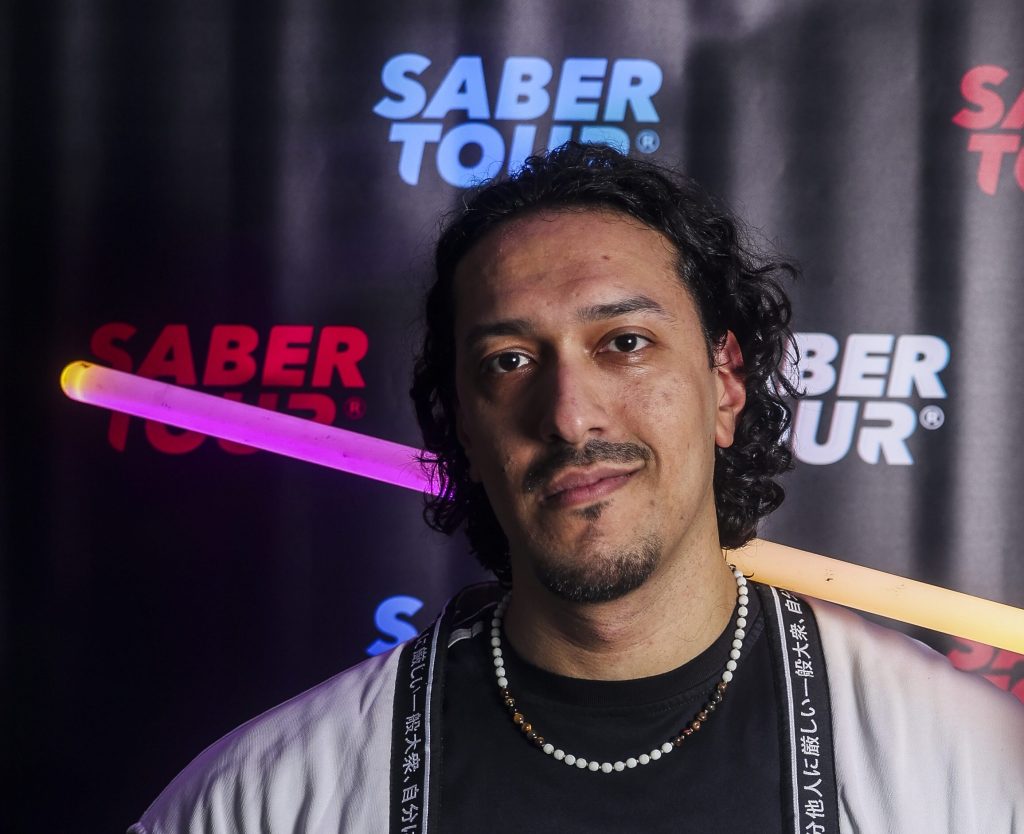
Jérémie, welcome to Saber Talk, let’s start at the beginning, how did you first get involved with LED Saber as a sport?
I’ve been a Star Wars fan for as long as I can remember. During my first years after finishing school, I came across a video of a Ludosport tournament, and it really struck a chord with me. For the first time, it felt like there was a way to make my passion a bit more real.
At the time, though, I was living in Dijon as a student. There weren’t any clubs nearby, and I simply couldn’t afford a club membership alongside my studies.
It was only after finishing my studies and moving to Paris that I was finally able to properly start. In the meantime, I’d discovered the Sport Saber League, whose approach appealed to me even more.
One Wednesday evening, I walked through the club doors… and that’s where the adventure began.
You typically fight with a yellow saber, did anything in particular draw you to that colour?
If you look at the different lightsaber colours across the Star Wars universe, yellow is definitely one of the least represented. Perhaps that’s because, within the saga, it’s seen as quite a rare colour, usually associated with the Temple Guards in the animated series and video games.
When I first started training, I actually used a green saber because of the symbolism attached to it in Star Wars lore. But over time, yellow (or more of an amber shade) felt like the most natural choice if I wanted to stand out a little more.
You’re based at SSL Paris – what’s the club like? What does a typical training session look like for you?
The club is a bit like Paris itself: you’ll find all sorts of personalities and fighting styles there, and everyone comes looking for something slightly different. Some are drawn to the sporting side, others to the technical aspect, competition, or simply the enjoyment of practising.
We’re fortunate enough to have quite a long training slot on Monday evenings, which gives us the chance to work in real depth.
For me, a typical training session is split into two parts. First, there’s the group session: warm-up, themed drills, and then applied sparring.
After that comes the more “in-depth” part, where we try to fit in as many bouts as possible to work on the areas each fighter wants to improve, with fatigue adding an extra layer to manage as well.
As one the three best fighters in the world, you’re a highly respected combatant, how would you sum up your style in the arena?
“In the world” might be a bit of an overstatement, but thank you for holding me in such high regard!
Honestly, my style is quite difficult to define. I feel as though I’m constantly evolving and never really settling into one fixed identity. I like to think I take little bits of inspiration from everyone I fight or train with.
A number of people have told me there’s something very fluid, almost hypnotic, about the way my blade moves, and in the end that’s probably the aesthetic that suits me best.
You are also one of the Tour’s finest referees, what first drew you into the world of refereeing, and what do you find most rewarding about it?
For me, it’s all connected. The best fighters often make the best referees, so if you truly want to improve, you need to develop every aspect of your understanding of the sport.
Being able to read the structure of a match and recognise what works and what doesn’t is essential if you want to keep progressing as a competitor.
On top of that, for a sport to genuinely grow, everyone has to contribute. I also wanted to lead by example and give the referees already in place a bit more breathing room.
We have the 9th edition of the Open de France just around the corner, how do you typically prepare for an event like this? Is it just an extension of normal training or do you increase the amount you practice in the run-up to the event?
I don’t really have a specific physical preparation routine as such. The roadmap of things I need to improve is always there (and, unfortunately, more or less unchanged for quite some time) so it’s not really the moment, just before a competition, to start working on entirely new elements.
On the other hand, I try to put more emphasis on the mental side of preparation. That’s something I still need to strengthen, so I’m less affected by fluctuations or external factors on the day that could pull me away from my overall game plan.
And then, between us, a few good weekends with friends, plenty of time in the pool, and the occasional well-earned drink all help to keep things balanced while waiting for the big day!
Is there a fighter you really admire, either for their approach to combat or their overall style in combat?
Honestly, there are a lot of fighters I admire, all for very different reasons.
But there are two in particular who have always fascinated me: François Ducrohet and Aurel Amegah.
First of all, the level they’ve managed to maintain over the years is incredibly impressive. But more than that, they both have extremely explosive styles. Having faced them several times in competition, they’re among the very few fighters who genuinely made me feel as though I was standing opposite wild animals.
The aura they bring into a match is intimidating, but also completely captivating.
A lot of fighters will listen to music while warming up or practicing, is this something you’ve ever given a try? If so, did you find it helped you to focus or improve your performance at all?
Absolutely! Music is a huge part of my life, and not just when it comes to sport. (For fun, my Spotify stats seem to get more ridiculous every single year!)
I think it’s a brilliant way to shut yourself off from the outside world and really get into the right headspace before a fight.
That said, it can also be a bit of a double-edged sword. Certain songs can put you in a psychological (or even physiological) state that isn’t always ideal just before competition, especially when it comes to your heart rate and overall intensity levels.
LED Saber has seen a huge surge in popularity in recent years, what do you think makes it so special? And what would you say is one misconception that most people have about the sport?
A lot of the communication around LED Saber has helped push things in that direction, and that’s a real opportunity for the sport. People and organisations that previously knew nothing about the discipline are now starting to take an interest in it, and above all it means we keep meeting new people to share the arena with.
The biggest misconception is obviously the connection to Star Wars and geek culture. Yes, our sport takes direct inspiration from one of the most iconic franchises in pop culture, but that doesn’t make it any less serious.
Behind the aesthetic, there’s a genuinely physical, technical, and competitive discipline that becomes more professional year after year. So in reality, it’s very far removed from being just a bit of fun between fans.
What would you say is the most rewarding part of competing in the international tournament system for you?
The international aspect is a real bonus. On the one hand, it allows you to meet people from very different backgrounds, and on the other, it also gives you the chance to travel and share genuine experiences with the people you go with, which really helps to strengthen those bonds.
In the long term, I’d love for the saber circuit to develop an aura similar to the UFC, where every event feels like a true celebration of lightsaber combat.
Do you have a favourite match from any tournament you’ve attended? If so, who was it against—and why does it stand out to you?
The third-place match against Guillaume Pevée at the most recent French Open in Charléty. It was another chapter in what you could call our “legendary” (and friendly) rivalry, but more importantly, it was the culmination of a tournament where I had approached the mental side differently, working with the coach of the day, Adrien Koch Forbin.
The intensity was incredible, and the atmosphere felt almost suspended like time had stopped. In that moment, only one thing mattered to me: giving him the most intense match possible, with complete respect. At that point, the result itself didn’t really matter anymore.
Finally, if you could step into the arena for a full three-round match under official Saber Tour rules against any opponent—historical or fictional—who would you choose to duel, and why?
Count Dooku firstly because Christopher Lee. And secondly… because Christopher Lee.
Beyond the actor, the character himself carries something I’d really love to experience in a duel. His style, his composure, and his presence are incredibly distinctive.
Of course, the lack of thrusting would put him at a clear disadvantage under our rules… but for the honour of facing him, perhaps we could make a small exception?


Leave a Reply