
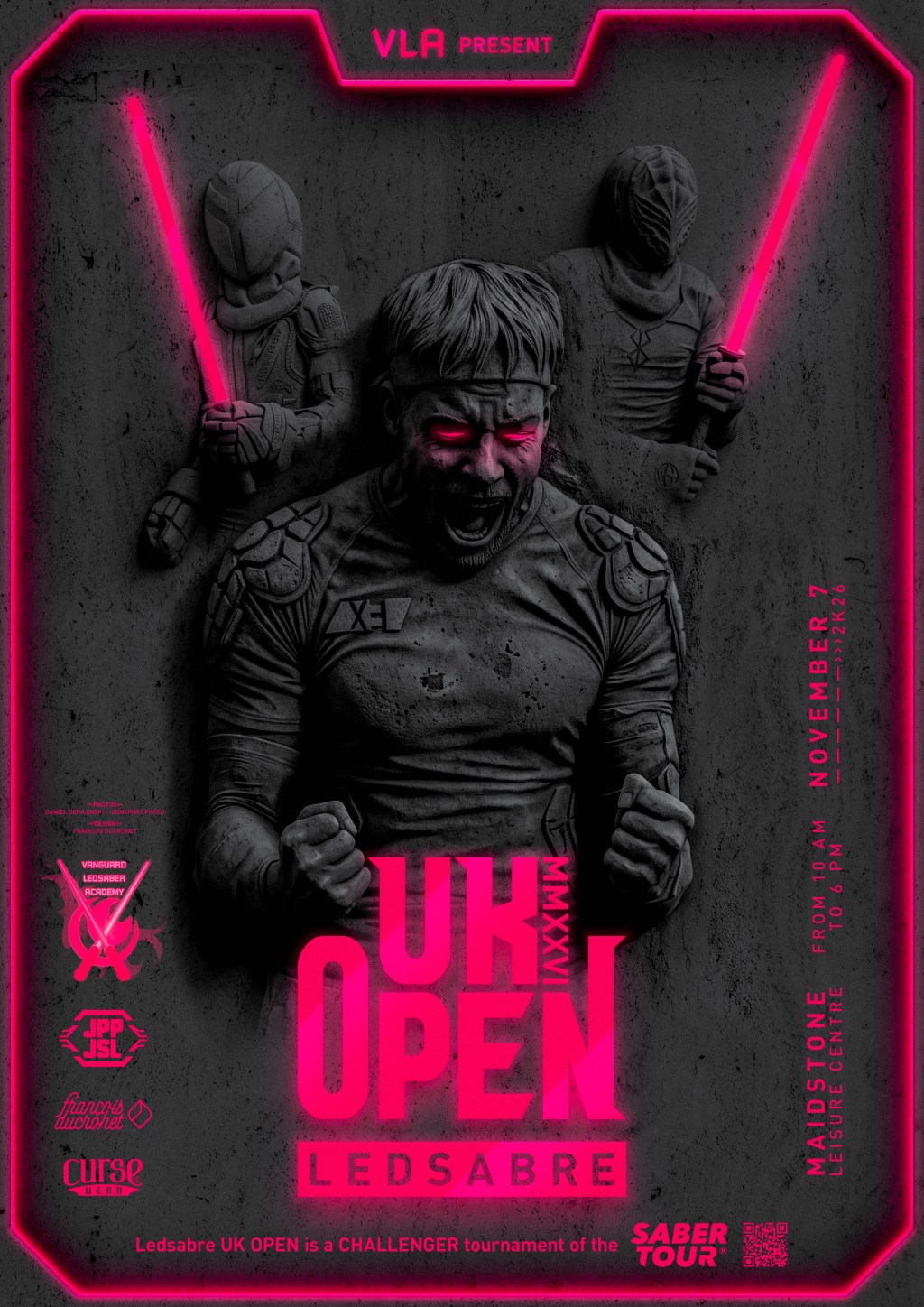
So, you’ve signed up for your first ever Saber Tour® Open event, you have all the gear you need, your transport (and accommodation if needed) is sorted.
Speaking as a fighter now entering my fourth Saber Tour event, here’s what you can expect on the day!
Arrival
You can arrive at the venue from around 9.30am, there is no formal sign-up, however Arthur Gautier (Saber Tour Sporting Director, taller figure pictured right)will be ensuring everyone has arrived before the scratch at 10.15am. So I would greatly recommend heading over to say hello to him, he’s also the best person to go to if you have any questions on the day!
Of course, I’ll also be around! (I am the smaller figure in the picture to the right). I’m always very happy to answer any questions, help explain if anything is unclear and ensure that you feel at home!
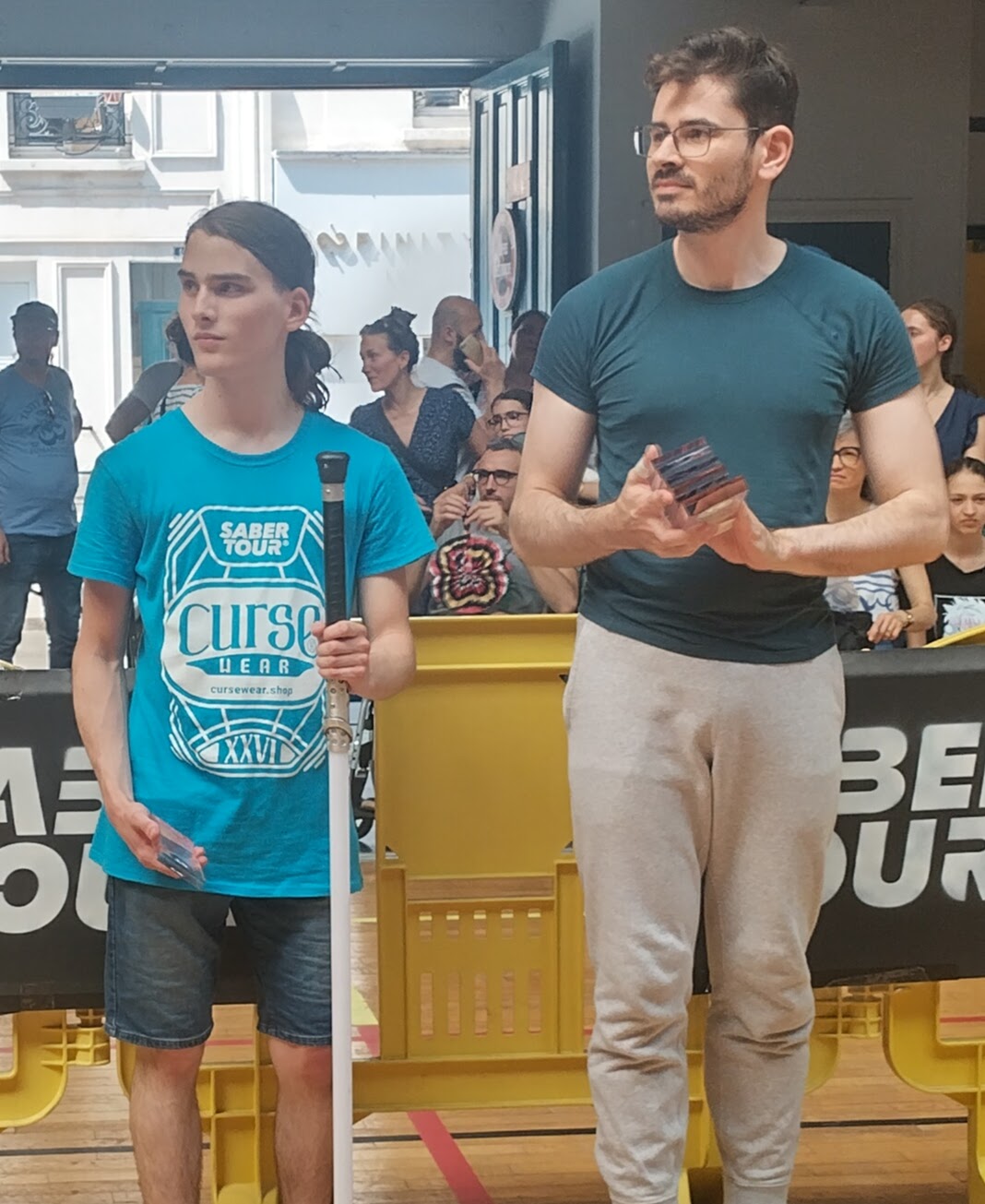
Before the pool stage begins, there will be a brief welcome from Adrien Koch Forbin (President of the Saber Tour) and from the hosts Vanguard LED Saber Academy, this will set the stage for the event to come and update people as to any changes occurring on the day (though those are usually rare).
The Format
As an event with dozens of fighters and a limited number of hours, the UK Open will take place across 3 arenas, all hosting matches simultaneously, in order to get all the pools done in time for the Direct Elimination (DE) matches in the afternoon. Each of these arenas has a team of 3 referees, who are in charge of the scoring. Refereeing a sport as fast-paced as ours isn’t easy, and mistakes will inevitably happen from time to time. These are not deliberate; sometimes the action simply happens too quickly for everything to be caught.
If they occur repeatedly, your best bet is to adjust the way you’re fighting and make your strikes clearer to the referees.
If you’re not sure what arena you’re in, don’t hesitate to ask another fighter or one of the organisers!
After the pool stage, we take a break for lunch and to let everyone rest after their morning of fighting and refereeing, before coming back for the Direct Elimination.
However I would also advise checking which wave you’re fighting in and potentially using a break in the action to eat, as the pools will continue past midday, so there is no need to wait for the official break for lunch!
Because of the small number of fighters attending the UK Open, every fighter is guaranteed a DE match. The way this will work is that the lowest ranks will have a “playoff” of sorts to determine which of those fighters qualify into the Table of 32, which most fighters will have already qualified for.
As we are currently at 34 fighters, this will result in two playoff matches with seeds 31-vs-34 and 32-vs-33, the lowest four spots of the bracket.
Direct Elimination matches are identical to pool stage matches for the playoffs, the Table of 32 and the Table of 16. For the Quarter-Finals, matches increase to 4 rounds, and for the Semi-Finals and Final we will have matches of 5 rounds.
If, at the end of all rounds, a DE match is tied (and both fighters have won the same number of rounds) it will go to Golden Touch. In this case both fighters enter a sudden death round with 2HP apiece; the first fighter to reach 0HP is eliminated. If both reach 0HP simultaneously, the Golden Touch is replayed.
Scoring Points
Here’s a quick refresher on the scoring system ahead of the tournament:
- Each match in the Pool Stage consists of 3 rounds of 5 points.
- Each fighter begins every round with 5 Hitpoints, those are then depleted by any valid strikes that are made.
- The round ends either when one fighter has reached 0HP, or when the timer of 1 minute 30 seconds has expired.
- The score in a match consists of the sum of each fighters’ score across all the rounds.
- A perfect victory, therefore, would be 15-0.
For example, in a match between Fighter A and Fighter B, Fighter A wins round 1 1-0, B takes round 2 2-0 and round 3 is a 0-0 tie. This means that Fighter A finishes the match with one point and B finishes with 2. Making the final score 2-1 to Fighter B.
Ranking the Pools
The ordering of fighters within pools is, unlike other well-known sports like Football, not decided by how many matches you win. It is the total margin of victory across the whole pool, with win percentage as a tie breaker.
Losses and ties give 0 points towards your total.
What this means is the more points you can hold on to, the better seeded you will be. Winning a single match 5-0 is worth more than winning 4 matches 1-0.
Your opponent in the Direct Eliminations will be determined by how well you perform in the pool stage. Essentially, the better you do in the pools, the easier your opponent in the Eliminations will be.
If you want more detail…
(This bit is mainly for stats nerds, it is totally fine to skim over this as it is not necessary.)
The Elimination stage is seeded by the rank of each fighter in their pool, and then their score (their margin of victory divided by the total possible margin of victory, this only applies in Elimination seeding).
For example:
- Amaury and Sébastien both came 1st in their pool. Amaury’s pool had 5 fighters, while Sébastien’s had 4.
- Amaury finished with a 45HP total margin of victory from 4 matches. Giving him a score of 45/60 = 0.75.
- Sébastien finished with a 40HP total margin of victory from 3 matches. Giving him a score of 40/45 = 0.888…
- Sébastien’s score is higher, so he is the higher seed going into the Eliminations.
The Table of 32 bracket is then seeded as 1vs32, 2vs31, etc.
There is no redraw if a match already occurred in the pool stages, pool stage rematches are certainly possible!
Food & Drink
I cannot stress this enough, please bring food and water to the event! It’s a long day and you will most likely find yourself hungry and thirsty throughout the day, especially because (as this is a smaller event) all fighters are guaranteed a spot in the Direct Elimination rounds it is certain that you will have match(es) in the afternoon as well as the morning!
The Saber Tour will provide pizza for all attendees around lunch time, after the completion of the pool stage, but I would still encourage you to bring your own provisions!
The Fighting Environment
The first event you attend is always intimidating, especially when there are various chaotic events and activities that you don’t quite understand. So here is a rundown of things you may not have been expecting:
- Fighters may shout. Some of those competing (myself included!), and especially those in the higher ranks, will occasionally shout at the end of an action or exchange. This can happen for a variety of reasons: to keep adrenaline flowing and stay in the game, to celebrate a particularly good performance, or simply because of the excitement and pressure of competition. It isn’t necessarily directed at you, and usually isn’t meant as an intimidation tactic, so don’t take it personally! If this happens in a match with you, take it as a compliment. It means you presented a challenge and your adversary was worried you might take them down!
- However, if your opponent’s shouting is causing you discomfort or presenting a problem in any way, do not hesitate to speak to your referee about it!
- Allez ! If you’re not one of our guests from France and don’t speak French, this may be confusing at first. It is simply a call of “Let’s Go!” meant to encourage teammates or friends, or even prospective newcomers! You’ll likely hear it many times.
Tournament Etiquette
There are a few customs we use in Tournaments, some are written into the rules, others have been developed over time by our fighters.
In The Rules
- Salute. This is called at the start of the match. It is a display of respect to your opponent and the referees. Some fighters have developed personal salutes, and you can do this if you wish! If you’re unsure, simply bowing to the referees and your opponent will suffice.
- When the referee calls Halt, remain where you are. The fight restarts from where it left off before the Halt was called, there is no reset to the centre or anything like that.
Developed By Fighters
- Blade checks. Some fighters will start each round by coming to the middle of the arena with their blade extended. This is a blade check. If this occurs, they will be expecting you to tap blades with them. I’ll stress that not all fighters do this, and to any experienced fighters reading this I would strongly encourage you to clarify with your opponents about the blade check before the match starts! It makes the whole process more enjoyable (and less nerve-wracking!)
Quick Tips
- Bring a spare saber if you can! Whilst it’s unlikely that your saber will malfunction, the Saber Tour does not allow blades that are not illuminated to be used in matches (If it turns off midway through that’s okay, but it must light up at the start!). Having a second saber means that you can immediately swap it out instead of having to fix the issue.
- If you only have the one saber, you needn’t worry! As this is a lightsaber tournament there will be an abundance of weapons going spare if the worst comes to the worst.
- If there’s anything you’re unsure on, ask. If you’re in a match, you’re absolutely allowed to ask what the current round score is, how much time is left on the round, the score from other rounds up to that point, and anything else. Knowledge is important to decision making, the referees understand and a big part of the reason they are there is to ensure that you know what is going on.
Equipment
Being a standardised sport, the Saber Tour has restrictions on equipment and sabers, these are included in the rules document (which you can find on the Saber Tour website) but I’ll run over them again here.
The following is a summary of the equipment regulations, not a replacement for the official Saber Tour rules. If you’re unsure whether your equipment is compliant, check with the organisers before the tournament.
Protective Gear
You are required to have:
- A 350N Fencing Mask
- A Cup/Box (only mandatory for men and anyone who identifies as male)
- Elbow pads
- Knee pads
- Protective gloves
- Shoes
As for your outfit, that’s up to you! We have a huge variety of aesthetics and approaches; as long as your attire is suitable for a public, athletic activity you can wear what you wish!
Sabers
The Blade:
- Blades must be between 62 and 92cm long, and have a wall thickness of 1.5mm to 2mm.
- Unless you have specifically purchased a heavy-grade blade the wall thickness will not be an issue, so don’t worry too much about that.
- Blades must have a round tip. Bullet tips are prohibited.
The Hilt:
- Minimum emitter length is 5cm.
- The emitter being the piece that holds the blade.
- The maximum diameter of the emitter is 5cm.
- Again, almost every standard saber adheres to this, it shouldn’t be too much of an issue.
- Your saber must not have sound. If sound is an option, it must be muted.
- Any form of dangerous protrusions or sharp edges are prohibited from a safety standpoint.
If your saber has additional guards or modifications it must meet these guidelines:
- Tsubas have a maximum radius of 6.5cm.
- Same for D-Guards.
- Crossguards have a maximum length (measured tip-to-tip) of 21cm.
A Final Word
The UK Open is a brilliant opportunity to test yourself, meet fighters from both the UK and France and experience Saber Tour at its best.
Make the most of the day. Watch other matches, speak to people from different clubs, ask questions and get involved. There’s plenty going on beyond your own matches, and some of the best parts of a tournament can happen away from the arena.
This is an opportunity to learn and pick up new techniques. If you lose a match because of a tactic you’d never seen before, you can ask your opponent about it and learn to use it yourself!
I’ll be avaliable for any questions you may, either on Discord (via the Saber Tour server) or via email at henleywilliam01@gmail.com.
Good luck, enjoy the competition, and I’ll see you on Saturday!


Leave a Reply